
Capability

Your colour, matched and documented.

Production
Selected projects from 50 pieces
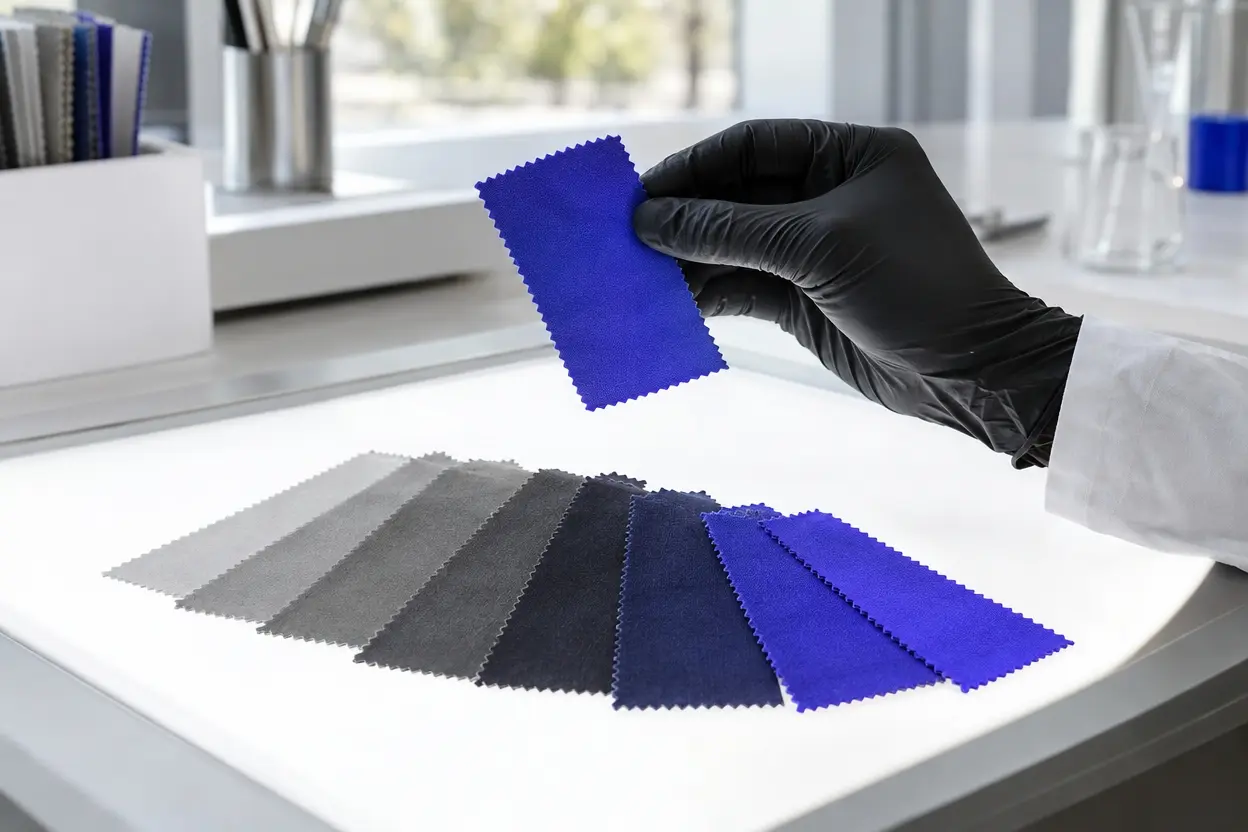
A hand fanning small navy lab dip swatches in graduated shades beside dye pots

Send a Pantone reference, a fabric swatch or a physical sample. We produce lab dips, you approve one, and that dip becomes the colour standard for every future order.

Reference
Pantone TCX, swatch or sample

In detail

  1. 01

    Colour matching depends on fibre: the same reference can look different on cotton and polyester, so each fabric gets its own approved dip.

Production from

50 pieces per style

Every quote

Written, priced per piece

Before bulk

You approve a sample

Your brand colour should look the same on every garment you sell

A brand colour is one of the most valuable things a label owns, and it is also one of the hardest to reproduce in textiles. The same shade looks different on cotton and on polyester, on a matte and a glossy surface, in daylight and under shop lighting. Custom colour development is the work of matching a colour you supply, on the fabric you have chosen, and keeping it consistent from one order to the next.

This page explains how custom colours are developed, what you need to provide, how colours are approved, what limits to expect and how to keep a colour stable across reorders. It is written for brands, teams and buyers who need a specific colour, not just a colour from a standard range.
Have a design or an idea?

Send it and get a written quote.

Request a quote

How a colour is matched

Matching starts with a reference and ends with an approved lab dip.

  1. 01

    You provide a reference a physical swatch, a colour code or an existing garment.

  2. 02

    We confirm the fabric the colour will be dyed on, since fibre and construction affect shade.

  3. 03

    Lab dips are dyed in the target colour, often in several close variations.

  4. 04

    You review them under agreed light and choose, or comment with direction.

  5. 05

    The approved lab dip becomes the standard for bulk.

This cycle may repeat once or twice until the colour is right. Starting with a clear reference shortens it.

What to provide

The better the reference, the closer the first attempt.

  • A physical swatch is a reliable reference, because it can be compared directly.
  • A colour code from a system such as Pantone can be used, with the caveat that printed and dyed colours differ.
  • A screen colour is a weak reference, because screens vary and cannot show fabric.
  • An existing garment works well if it is in the same fabric.

Also tell us the fabric, the quantity and the use, since these set what is feasible.

Fibre, fabric and the limits of a match

The same dye does not look the same on every fabric. Cotton, polyester, nylon and viscose each take colour differently, and a smooth fabric looks different from a textured one. A perfect match across two different fibres is sometimes not possible, and we tell you when this is the case.

Some colours are naturally harder: deep blacks, saturated reds, bright whites and fluorescent shades each need care. Some bright colours may not meet fastness targets on certain fibres. We are honest about what can be achieved, because a promised match that cannot be held in bulk is worse than a clear limit stated in advance.

See the garment before you commit.

Order a physical sample in your fabric and fit. Bulk production starts only after you approve it.

Light, metamerism and how to judge colour

Colour is judged in light, and light changes it. Two colours that match in daylight can differ under shop lighting, a phenomenon called metamerism. When you approve a colour, look at it in the light your customers will see it in, and in daylight, and compare against the reference together.

  1. 01

    View the lab dip next to the reference under the same light.

  2. 02

    Try daylight, indoor light and, if relevant, shop lighting.

  3. 03

    View on the real fabric, not on a flat card.

  4. 04

    Approve only when satisfied in the conditions that matter.

We can help set up the review, and we record which standard the colour was approved against.

Minimums, timing and planning

Custom colours often have minimum quantities, because fabric must be dyed in a batch. A colour developed for a fabric that has to be dyed to order may require a quantity larger than your first run needs, and lab dip approval adds time before bulk dyeing can start.

We tell you about minimums early, and we advise whether a nearby standard colour may serve better for a small first run. If a colour is core to your brand, it is usually worth developing it properly and planning for the quantity.

Keeping a colour consistent over time

A colour approved once must be reproducible. Dye lots vary slightly, so we record the approved lab dip, the dye recipe reference where available and the lot used for each order, and we check bulk against the standard before cutting. For reorders, we start from the same approved reference.

If you will reorder over many seasons, consider keeping a physical standard swatch and sending it with each order. Where small variation between lots is natural, we tell you in advance so you can plan replacements and sets. Our dyeing page explains the technical background.

Start with your colour reference

Send us a physical swatch, a colour code or a reference garment, together with the fabric and quantity. We will respond in writing with what is feasible, any minimums and a lab dip plan. A development sample lets you judge the colour in a real garment. Made-to-order starts from 50 pieces per style.

Process

From first message to delivery.

Six steps, each confirmed in writing. Nothing goes into bulk production before you approve the sample.

  1. 01

    Enquiry

    Send your idea, tech pack or a reference garment through the quote form or by email.

    Day 1

  2. 02

    Quote and tech pack

    We confirm fabric, sizes, decoration and price per piece in writing.

  3. 03

    Sample

    A physical sample in your fabric and fit, sent to you for review.

  4. 04

    Approval

    You approve the sample or request changes. Bulk production starts only after your approval.

  5. 05

    Production and quality checks

    Bulk production with quality checks against the approved sample.

  6. 06

    Delivery

    Packed to your specification and shipped to your delivery address.

Inventory

Need garments now? Buy from inventory.

  • From 1 piece, any size or colour
  • Ready garments in our German warehouse
  • Live piece counts per size and colour
  • One quote request for the whole basket

Production

Your own design? Produce with us.

  • Selected projects from 50 pieces
  • Start from a sketch, tech pack or reference garment
  • Physical sample before bulk production
  • Every step confirmed in writing

Talk to us

Tell us what you need

Two lines are enough to start. A person on our team reads every message and replies in writing. We reply in writing within 24 hours.

Need to give quantities and a product category? Request a quote

Send us your brief. Get a clear answer.

Quantity, fabric, decoration and timeline. We confirm in writing what is possible, what it costs per piece and when it ships.