
Company

Quality, checked at every stage.

A final inspection table with folded garments in neat piles by colour, a measuring tape and a magnifying lamp

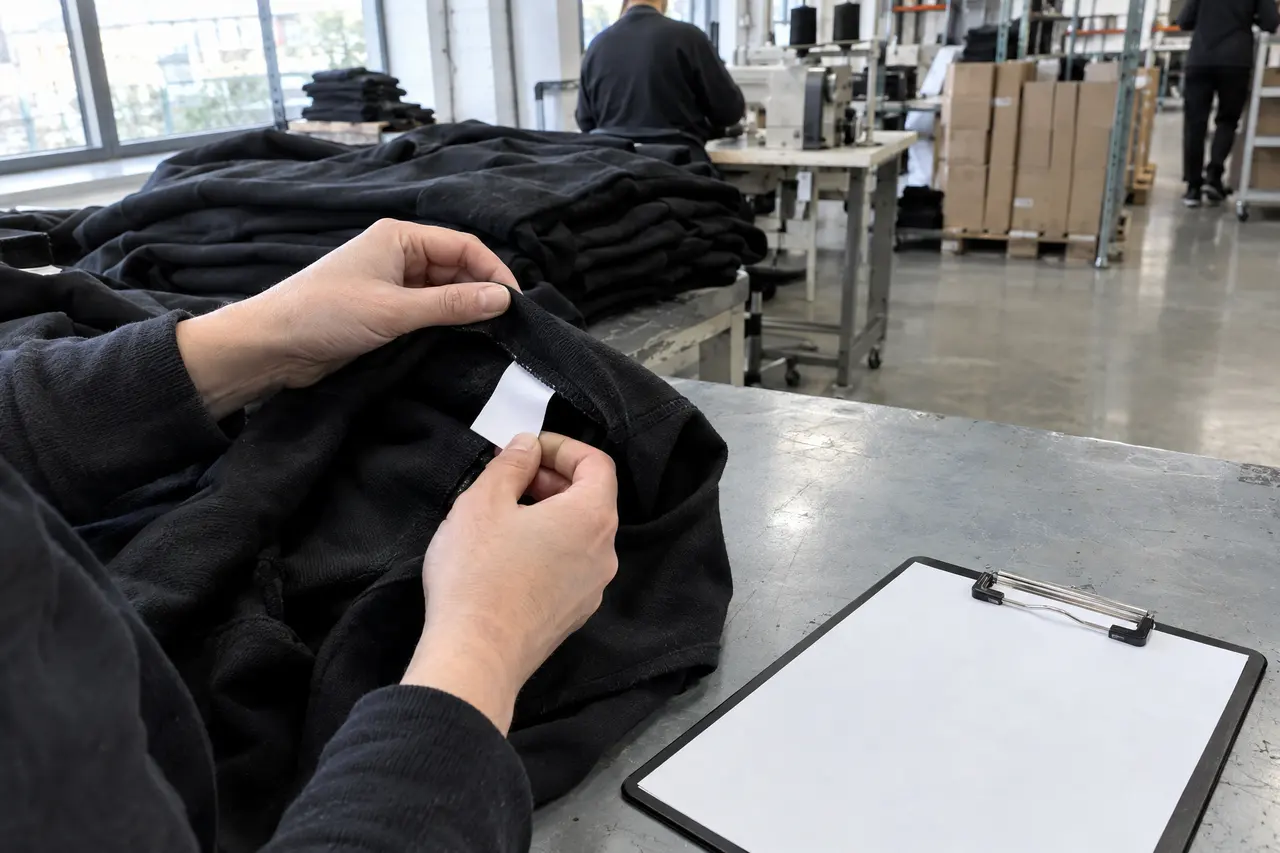
Quality assurance runs from incoming fabric inspection through in-line checks during sewing to a final AQL-based inspection before packing. See the quality assurance and inspection capability pages for the detail.

Standard
ISO 9001:2015
Inspection
AQL based, in-line and final

In detail

  1. 01

    ISO 9001:2015 covers our quality management system; see the certifications page for the certification body and scope.

Production from

50 pieces per style

Every quote

Written, priced per piece

Before bulk

You approve a sample

Quality is a process, not a promise

Every manufacturer says quality is a priority. What matters to a buyer is what happens between the sample and the shipped garment, and whether it can be checked.

Quality in clothing is the match between what you approved and what you receive, across every size and every reorder. It is not a feeling and it is not a logo. It is a reference, a set of tolerances and a series of checks against both.

This page explains how quality assurance works in practice, so you know what to ask of any supplier, including us.
Have a design or an idea?

Send it and get a written quote.

Request a quote

The approved sample is the reference

Everything starts with the sample. You review a physical garment, and you approve it or ask for changes. Once approved, it becomes the standard.

The measurements, the fabric, the construction and the decoration of that sample are recorded. When bulk is made, it is compared with the sample, not with a description of the sample. That is the difference between a quality check and an opinion.

Tolerances: how much difference is acceptable

No two garments are identical. Fabric stretches slightly, sewing varies by a few millimetres, and washing moves a measurement. The question is how much difference is acceptable.

A tolerance is a written limit: this measurement may vary by this much and no more. Without tolerances, a size medium can drift from order to order and nobody can say whether it is wrong. With them, a result is either within the limit or it is not.

We record tolerances against the approved sample before production, so there is a reference to check bulk against.

Checks before, during and after sewing

Checking at one point is not enough, because problems arise at different stages.

  • Fabric compared with the approved sample before cutting, for weight, colour and handle.
  • During sewing garments are checked as they are made, so a problem is caught early rather than on the whole run.
  • Finished goods compared with the approved sample and the recorded tolerances.
  • Decoration and labels placement, size and colour checked against the approved sample.
  • Packing quantities, sizes and labelling checked before the goods are closed.

See our quality assurance and inspection capability pages for the detail of each step.

See the garment before you commit.

Order a physical sample in your fabric and fit. Bulk production starts only after you approve it.

Inspection and what a sampling plan means

For larger orders it is not practical to measure every garment, so inspection often uses a sampling plan. A number of garments are drawn from the lot and checked, and the number of defects found decides whether the lot passes.

An acceptable quality limit, often shortened to AQL, is the agreed level of defects a lot may contain and still pass. Different defects are weighted differently: a cosmetic mark is not the same as a split seam.

We agree the inspection approach with you in writing, so you know how the goods will be checked and what a pass means before production starts.

Certificates and testing: ask to see them

Some buyers need more than an inspection. They need a test report or a certificate: fibre content, colour fastness, shrinkage or a safety test. Others need a management system or audit.

Our certifications page lists the certifications we hold with the issuing body, reference and scope, and links to verify them independently. If your customers require a particular test or standard, tell us at the start. We confirm in writing whether the specification can meet it, and we coordinate laboratory testing where it is needed.

Whatever a supplier tells you, ask to see the document and check the reference.

What you see before the goods ship

The most useful quality feature for a buyer is simple: seeing the result before the goods leave.

We share the inspection results with you before shipping. If something is outside tolerance, you see it while it can still be put right, not after the parcel has arrived. That also changes the conversation. Instead of arguing about what happened, you are looking at the same record.

If you need results in a particular format, or photographs of specific details, say so at the start and we will agree how to provide them.

Ask us to show an example of inspection documentation as well. It shows how we record findings and lets you judge whether it fits your requirements.

Start with a sample

A good way to understand a supplier's quality is to hold their work. A sample shows you the fabric, the stitching, the labels and the finish, and it becomes the reference for everything that follows.

Send us what you have and ask for a quote and a sample. They are small, reversible steps that give you real information before any bulk decision.

Talk to us

Tell us what you need

Two lines are enough to start. A person on our team reads every message and replies in writing. We reply in writing within 24 hours.

Need to give quantities and a product category? Request a quote

Send us your brief. Get a clear answer.

Quantity, fabric, decoration and timeline. We confirm in writing what is possible, what it costs per piece and when it ships.