







Guide
Clothing minimum order quantity (MOQ) explained
A minimum order quantity is the smallest run a manufacturer can produce sensibly. This guide explains where MOQs come from, how they are counted, and how to start small without forcing a custom run.
2026-10-30
Short answer
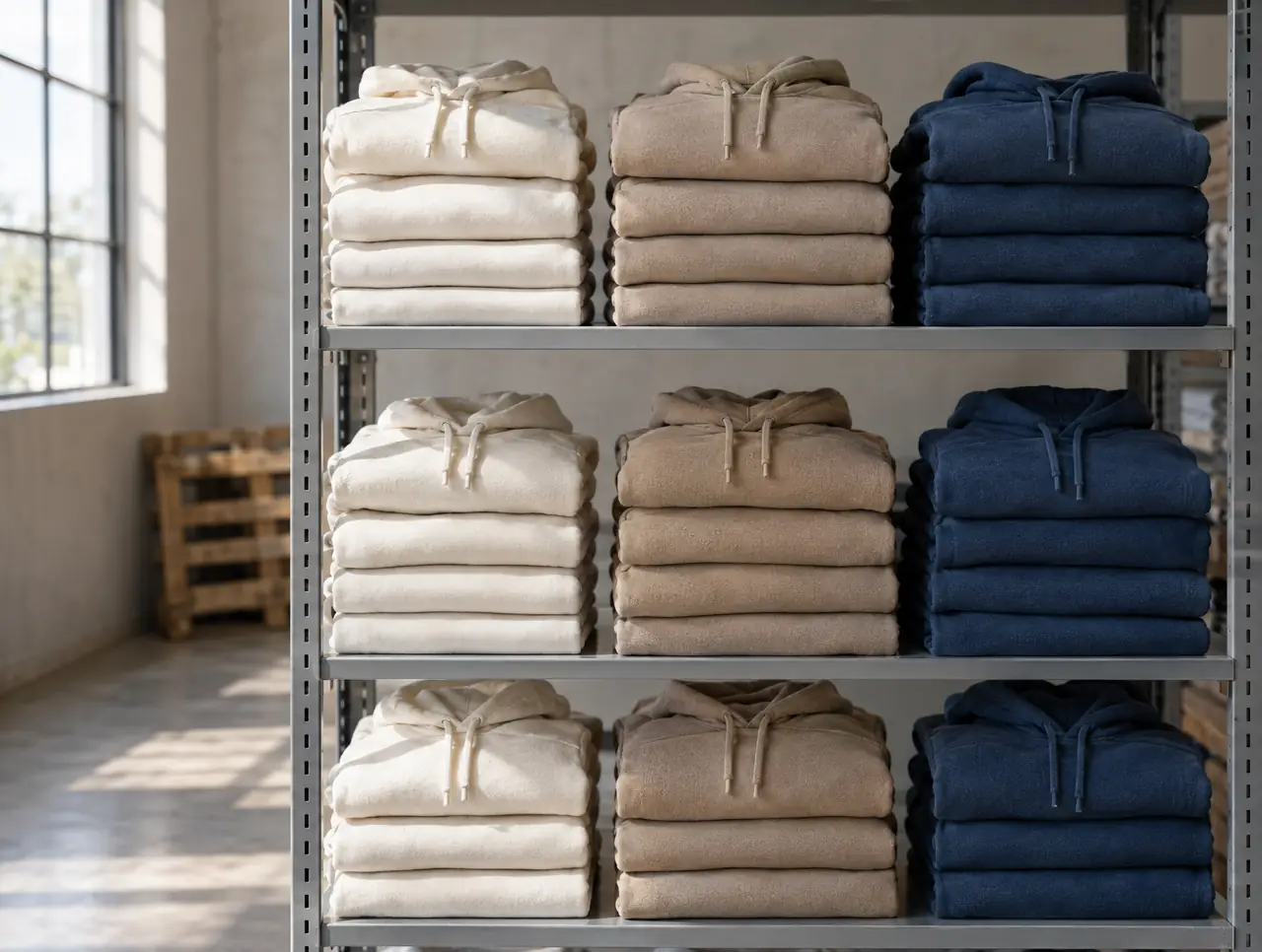
A clothing manufacturer MOQ is the smallest quantity the manufacturer will produce for one style, because cutting, sewing and setting up a run take the same effort whether the order is large or small. At Daylo Casuals, custom, private label and white label production starts from 50 pieces per style on selected projects, subject to technical review. If you need fewer, ready stock is available from 1 piece.
The rest of this guide explains where that number comes from, how it is counted, and which choices make a small run easier.
Why minimum order quantities exist
Making a garment is not only about sewing. Before a single piece is finished, someone has to prepare the pattern, grade it across sizes, source the fabric and trims, make a sample, set up the cutting and plan the sewing line. Much of that work is the same for 20 pieces as it is for 500.
A minimum order quantity exists so that this fixed effort is spread over enough garments to make the run sensible. It is not designed to block small brands. It is a reflection of how production actually works.
What fixed work sits behind every style?
Pattern making and grading are done once per style, regardless of how many pieces follow. The same applies to marking the cutting layout and preparing the sewing line. These steps cost time before any garment exists.
That is why a style ordered in a very small number carries the same preparation as one ordered in a larger number, and why manufacturers set a floor.
Why does fabric add its own limit?
Mills and suppliers sell material in rolls or set lengths, and dyeing or finishing is done in batches. A manufacturer who has to buy more material than your order needs must either pass that on or decline the project. Understanding how material sourcing works makes it easier to see why the minimum is not arbitrary.
Per style, per colour or per size
MOQs can be counted in different ways, and it is important to ask which one applies. The most common method is per style: the minimum applies to one design, and you divide those pieces across the sizes and colours you want.
Is the minimum counted per style or per colour?
Some manufacturers count per colour instead, which means each colour of the same design must reach the minimum on its own. This changes your plan a lot. Three colours at a per-colour minimum means three times the quantity of one colour at a per-style minimum.
Does the size split matter?
Per size is rare as a minimum, but size spread still matters. A balanced split across your sizes is easier to produce than a very uneven one. Ask for the rule in writing so you can plan your range around it.
How does Daylo Casuals state its minimum?
Daylo Casuals states its starting point per style: from 50 pieces per style on selected projects, subject to technical review. The technical review looks at the garment, the fabric and the decoration to confirm the project is practical to produce at that quantity.
How fabric and trims affect the minimum
A garment in a standard fabric that is easy to source usually has a more flexible minimum than one that needs a special weight, a custom colour or a specific finish. Custom dyeing, for example, generally needs larger batches than choosing from existing colours.
Trims work the same way. Standard zips, buttons and drawcords are easy to obtain in small amounts. Custom items such as engraved buttons, branded zip pullers or specially woven labels may have their own minimums, and those can set the real floor for your order.
When you send a brief, list every fabric and trim you want, and say where you are flexible. Choosing an existing option instead of a custom one is one of the simplest ways to make a small run practical.
How decoration changes the picture
Print, embroidery, patches and woven labels each need their own set-up. Artwork must be prepared, screens or digitised files must be made, and the result must be checked on the actual fabric.
Which decoration methods are simplest at low quantity?
A single small chest embroidery is a simpler job than a multi-colour screen print on the front, back and sleeves. The number of placements and colours in your decoration can affect what is practical.
If you are working to a small quantity, keep the decoration simple on your first run. You can always add detail on the next order once you know the garment sells.
How to start small
Start with fewer styles, not fewer pieces per style. A focused range of one or two strong garments reaches a sensible minimum more easily than ten styles in tiny quantities, and it is simpler to market too.
Limit your colours at first, use available fabrics and standard trims where you can, and keep decoration restrained. Then use the first run to learn what your customers buy before widening the range.
Can I test demand before a custom run?
Yes. Daylo Casuals holds ready stock that is available from 1 piece and dispatched from its warehouse near Frankfurt, with its own delivery. It is a separate offer from custom production, which makes it a practical way to try products and gather real customer feedback.
Ready stock as the alternative
If your quantity is below the production minimum, or you need goods quickly, ready stock avoids the minimum altogether. The garments already exist, so there is no sample stage and no production wait.
The trade-off is choice. Ready stock covers what is already available, while custom production lets you decide the fabric, fit, colour and branding. Many brands use both: ready stock to test and fill gaps, custom production for the core range they want to own. The guide on ready stock versus made to order compares the two in more detail.
A simple way to decide is to ask three questions. Do you need a specific fabric or fit that stock cannot offer? Is the garment central to your brand? Can you commit to the minimum for at least one style? If the answer to all three is yes, a custom run is worth planning. If not, start with stock and revisit custom production once you have real sales to guide the quantity.
Frequently asked questions
What is the minimum order quantity at Daylo Casuals?
For custom, private label and white label production, selected projects start from 50 pieces per style, subject to technical review. Ready stock is available from 1 piece.
Is the minimum per style or per colour?
Our starting point is stated per style. Because details such as fabric, colours and decoration can affect what is practical, the technical review confirms the quantity for your project.
Can I order fewer than 50 pieces?
Not for custom production, but you can buy ready stock from 1 piece. It is dispatched from the German warehouse with its own delivery.
Does the minimum change with the garment?
It can. Fabric, trims and decoration all influence what is practical, which is why selected projects are reviewed technically before a written quote is issued.
Send us your brief and we will reply in writing within 24 hours with a written quote priced per piece. If you want to test a product first, ready stock is available from 1 piece.
Request a quote · Browse ready stock · See the designs we make