







Guide
How leather jackets are made for brands: leather, suede, lining and hardware
A plain guide to how custom leather jackets are planned and built for brands, from choosing leather or suede to approving a sample. Read it before you write your brief.
2026-10-30
Short answer
A custom leather jacket is built from selected hides that are cut into panels, lined, fitted with zips and hardware, and approved as a physical sample before bulk production. The big decisions are leather or suede, the cut, the lining and the hardware. At Daylo Casuals, a jacket manufacturer for brands, custom and private label projects start from 50 pieces per style, subject to technical review, and every quote is written and priced per piece.
Leather versus suede
Both materials come from the hide, but they behave differently on the body and in the wardrobe. Neither one is better in general. The right choice depends on your customer, your climate and how the jacket will be worn. It also depends on how much care your customers are willing to give the jacket, because smooth leather forgives daily use more readily than suede does. Thinking about these points before you brief saves a round of changes later, and it helps us suggest a hide that matches the look you are describing.
What is smooth leather suited to?
Leather jackets are usually made from the outer, smooth side of the hide. The surface can be left natural, dyed, or finished with a light coating. Smooth leather tends to look sharper, resists light moisture better, and develops marks and softness with wear. This is the classic choice for biker and racer styles.
What is suede best suited to?
Suede is leather with the surface brushed into a soft nap. It feels warm and quiet, and it photographs well, but it marks more easily, takes up water, and needs more careful handling. It suits bombers, trucker styles and softer, relaxed shapes.
How do weight and feel change the jacket?
Be clear in your brief about which material you want, and about the weight and feel. A thin, supple hide drapes and moves easily. A thicker hide holds a structured shape but feels stiffer at first. Tell us who wears the jacket and when, and we can advise what is realistic. Sourcing the right hide is part of material sourcing, so the earlier you share these details, the better the match.
Cuts brands commonly ask for
Enquiries usually fall into a few familiar families, and you do not have to copy one of them exactly.
Which leather jacket cuts do brands ask for?
The biker jacket has an asymmetric front zip, a belt, and often shoulder snaps. The racer is cleaner and slimmer, with a short stand collar and little decoration. The bomber has a ribbed collar, cuffs and hem, and a straight zip. The trucker follows the denim trucker shape, with a chest pocket layout and a front button or zip. The flight jacket is heavier, often with a shearling-style or wide collar. The varsity jacket combines a body in one material with leather sleeves, and usually a chenille or embroidered badge.
Can I change a standard block?
Yes. Many brands take a standard block and change the length, the collar, the pocket placement or the sleeve width. Our designs catalogue is a useful place to find shapes to point at. A reference jacket, a technical drawing or clear photographs all help. If you send a reference, point out what to keep and what to change. A written tech pack keeps those notes in one place.
Cutting from hides
This is where leather differs most from cotton or fleece. Fabric comes on a roll with a consistent width. A hide is a natural piece with its own shape, thickness, grain and marks, and no two are the same.
Why are hides cut differently from fabric?
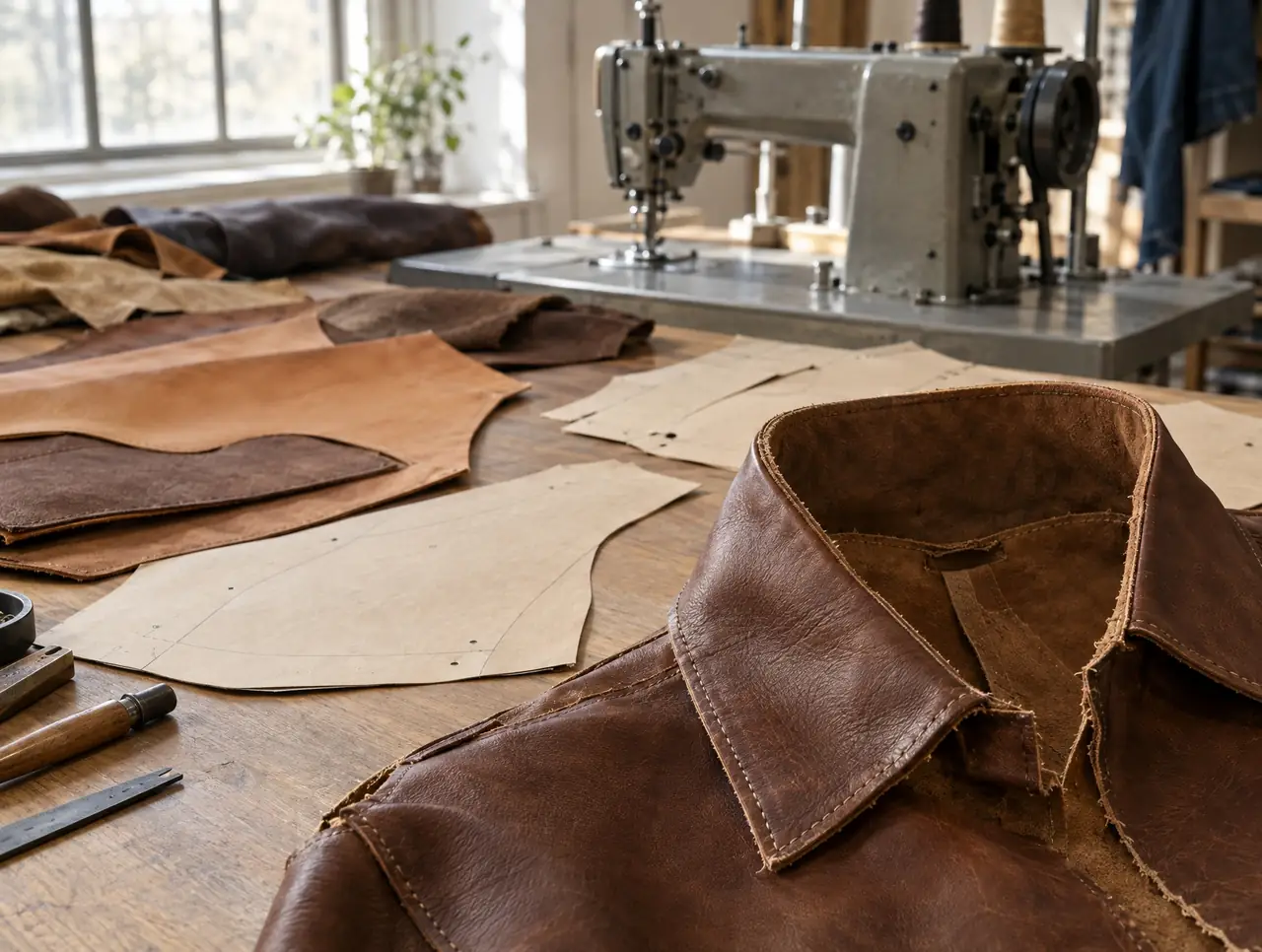
Areas such as the neck, belly and edges are looser or thinner than the back, and some hides carry scars or small flaws. Because of this, patterns are planned around the hide. The cutter places the main panels on the stronger, more even areas, uses the less even areas for smaller parts, and avoids flaws where they would show. This planning is part of pattern making for leather.
A pattern that wastes too much of the hide makes the jacket more expensive, so the layout matters for the quote as well as the look.
Is variation between jackets normal?
Yes. Grain and texture will not match perfectly from one jacket to the next, and that is part of what leather is. If your brand needs tighter consistency, say so early so the hides can be selected with that in mind.
Lining, zips and hardware
These are the parts a customer touches every time the jacket is worn, so they deserve as much attention as the leather.
Which lining should I choose?
The lining affects comfort, warmth and how easily the jacket goes on. Common options are smooth polyester or viscose-type linings, quilted linings for added warmth, and knit or pile for colder weather. Pockets inside the lining, a hanger loop and a neat inside label are small details customers notice.
How should zips and hardware be specified?
Zips are worth specifying carefully. Think about the zip type, the length, the colour of the tape and the finish of the teeth and puller. A heavy leather jacket needs a zip that is strong enough to take repeated use. Snaps, buckles, rivets, eyelets and belt hardware should match each other in finish, whether that is brushed, polished, antique or black.
Where can my logo go?
Your own logo can appear on the hardware, on a leather patch, as embossing or on the lining. Each method has its own limits, so it is better to decide early than to add it late. For label choices, see our guide to labels, hangtags, embroidery and print.
Colour matching between pieces
Colour is checked in several places: leather to leather across a production run, leather to lining, and leather to zips and trims. Dyed hides from different batches can vary slightly, and suede can look different depending on the direction of the nap. For this reason, panels for a single jacket are cut and sewn from matching material wherever possible.
Give a colour reference if you have one, such as a swatch, a physical garment or a clear colour code. Screens do not show leather colour reliably, so a physical comparison is more useful than a photo. Checks like these belong to quality assurance on every order.
Sample, care and what to brief
Every project moves through the same steps, and the sample is the point where your decisions become real.
What happens at the sample stage?
Before bulk production, you receive a physical sample to approve. Check the fit, the feel of the leather, the colour, the hardware and the details. Changes are far cheaper at this stage than after production has started. Only once you approve does bulk production begin. Our guide to the sampling process explains each round.
How should customers care for a leather jacket?
Tell your customers to keep the jacket on a wide hanger, away from direct heat and prolonged damp, and to take it to a leather specialist for cleaning rather than washing it. Suede in particular benefits from a soft brush and protective treatment suited to suede.
What should a good brief include?
A good brief includes the cut, leather or suede, weight and feel, colour, lining, zip and hardware choices, sizes and size spread, logo placement, quantity per style, and your timing. Add reference images wherever you can. Not sure about quantities? Read how minimum order quantities work before you decide.
Frequently asked questions
What is the minimum order for custom leather jackets?
Selected custom and private label projects start from 50 pieces per style, subject to technical review. The quote is written and priced per piece.
Will every jacket look exactly the same?
No. Hides are natural, so grain and small marks vary. Patterns are planned around each hide, and colour is checked across the run, but small variation is part of leather.
Can I see a sample before bulk production?
Yes. You receive a physical sample to approve first, and bulk production only starts after your approval.
Can I buy a small number of jackets first?
Ready stock is available from 1 piece and is dispatched from our German warehouse. It is a separate offer from custom production, with its own delivery. See what is currently available in ready stock.
Send us your brief with a reference image, the quantity per style and your timing, and we will reply in writing within 24 hours with a written quote. If you want to test the market first, ready stock is available from 1 piece.
Request a quote · Browse ready stock · See the designs we make